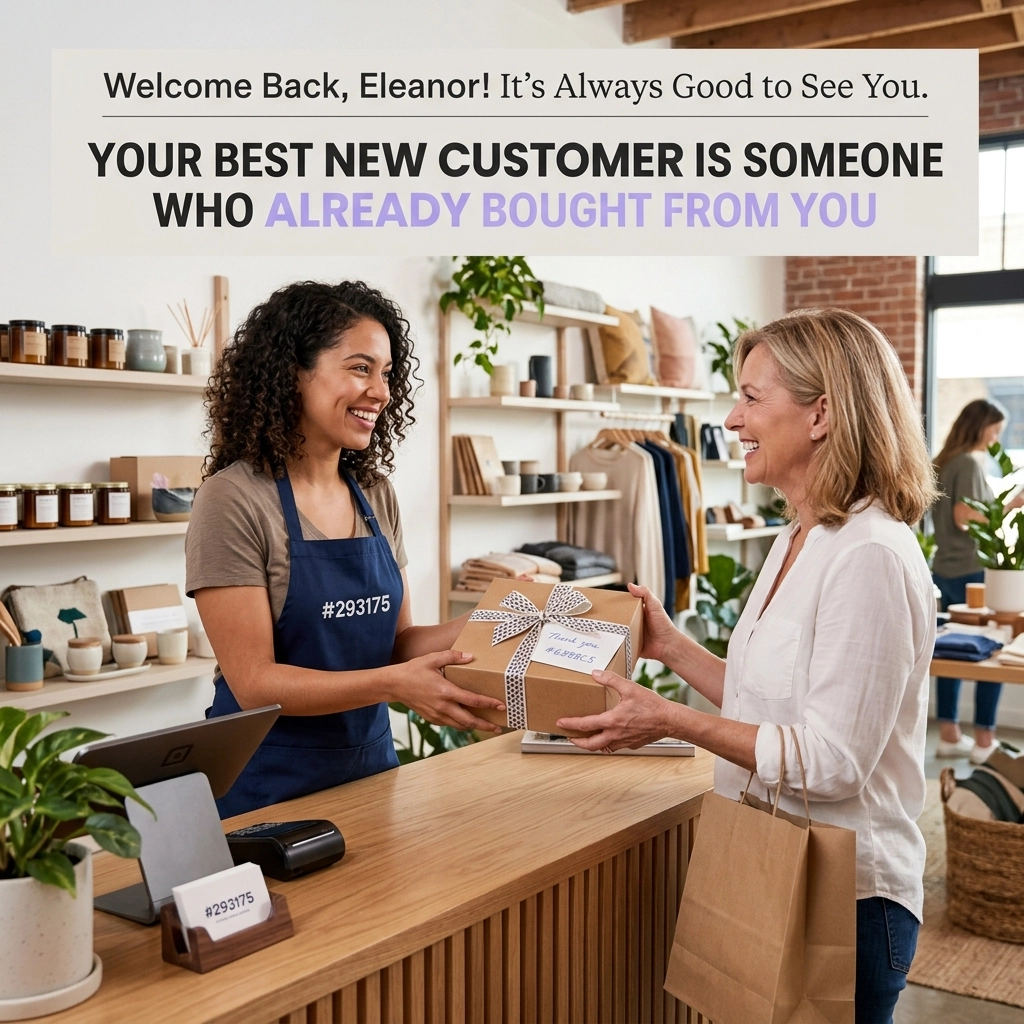


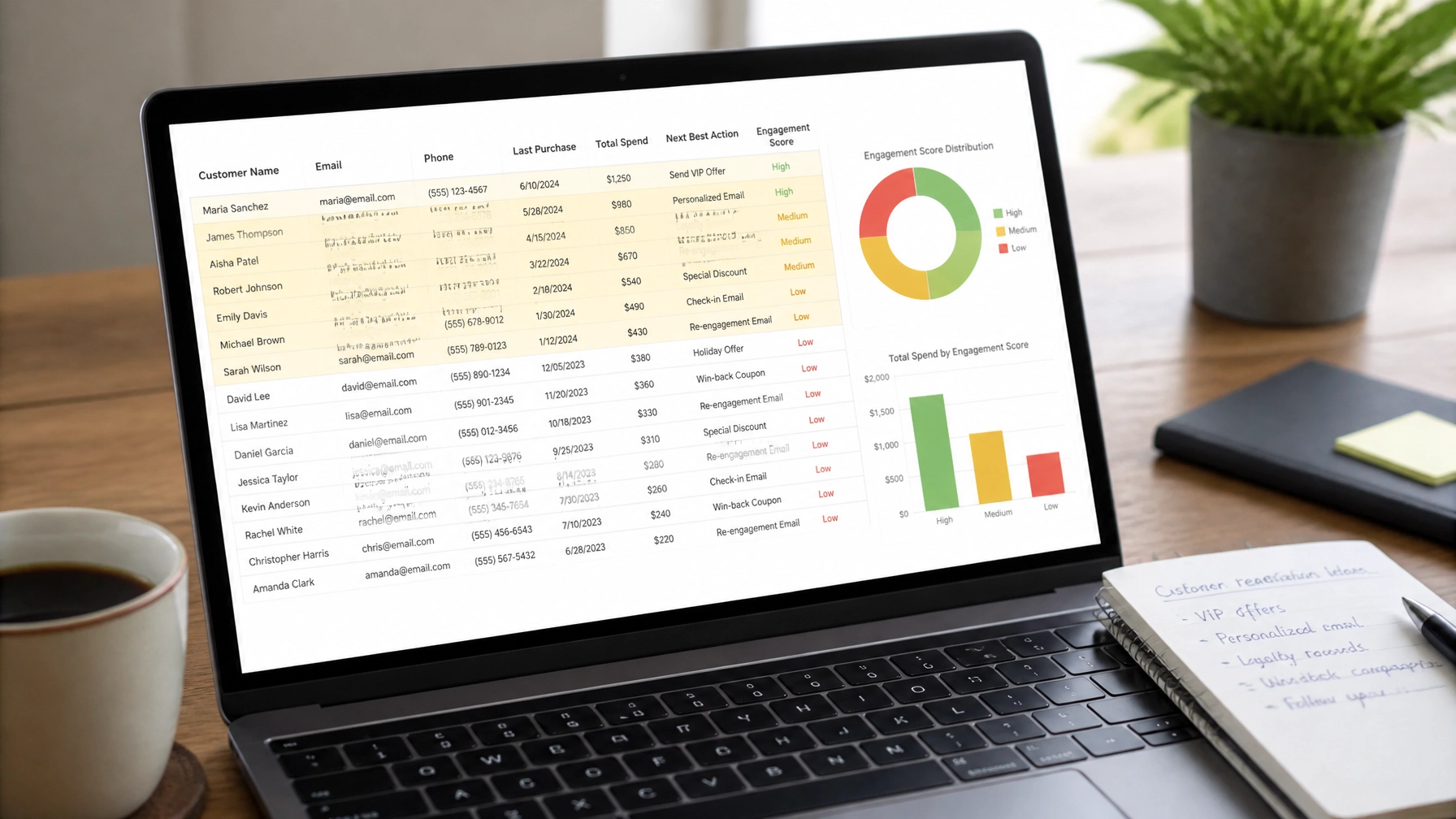
There’s a list sitting in your point-of-sale system, your CRM, or maybe just a spreadsheet on your computer. It contains the names and contact details of every person who has ever paid you money. For most small and medium businesses in the Windsor-Essex region, that list is the single most valuable asset they own. And for most of them, it hasn’t been touched in six months.
This article is about fixing that with one campaign you can run in 14 days, then repeat every quarter.
The Goldmine You’re Ignoring
Marketing budgets tend to flow in one direction: toward strangers. Google Ads to find new people. Facebook campaigns to introduce the business to fresh eyeballs. SEO to capture searchers who have never heard of you. All of that has its place, and we’ve covered why earning a customer’s first transaction is the hardest and most expensive part of growth in Your Best New Customer.
But here’s what gets lost in the chase for new traffic: someone who has already bought from you is between 5 and 10 times more likely to buy again than a stranger is to buy for the first time. The numbers vary by industry, but the direction is always the same. Past customers convert faster, spend more per visit, and require almost zero convincing.
Think about what a past customer represents. They found you. They evaluated you against alternatives. They handed over money. They experienced the product or service. They didn’t ask for a refund. Whatever objections a cold prospect might have, your past customer has already worked through and answered for themselves.
That’s a goldmine. And most business owners walk past it every day on their way to spend $40 per lead on Facebook.
Why They Stopped Coming Back
Before we get to the campaign, it helps to understand why past customers go quiet in the first place. Most business owners assume the worst: the customer was unhappy, found a competitor, or moved away. The data says otherwise.
Research from customer retention studies consistently finds that the number one reason customers stop buying from a business is not dissatisfaction. It’s something far less dramatic: they forgot.
Life gets busy. Their car needed servicing six months ago and they got it done at your shop. Today they need it serviced again, but they’re driving past three other shops on their commute and their brain is occupied with school pickup and the grocery list. Whoever happens to send them a text or pop into their inbox first is the shop they’ll book with.
That’s not disloyalty. That’s neurology. Out of sight, out of mind is a real cognitive pattern, not a marketing cliché. The customer doesn’t owe you a return visit, and they aren’t going to schedule one on their own initiative just because you did good work last time.
The implication is simple. If you want past customers to come back, you have to remind them you exist. You have to do it on a schedule. And you have to make it easy for them to take the next step in 30 seconds or less.
The One-Campaign Approach: 3 Messages Over 14 Days
A reactivation campaign doesn’t need to be complicated. Three messages, 14 days, one clear goal: get past customers to take one action that re-engages them with your business.
Here’s the structure.
Message 1, Day 1: “We Miss You” + Value
The first message has two jobs. It acknowledges the gap, and it gives the customer a reason to act now.
Don’t lead with the discount. Lead with the relationship. Something like:
“Hi Sarah, it’s been a few months since we saw you at the salon. We’ve missed you. Here’s $20 off your next visit if you book by the end of the month. Reply BOOK or call us at 519-XXX-XXXX.”
Note what that message does. It uses the customer’s name. It references the actual relationship. It offers genuine value (an actual dollar amount, not “savings up to…”). It gives a clear next step that takes 5 seconds.
What it does not do: explain your value proposition, list every service, attach a PDF brochure, or ask the customer to “click here to learn more about our updated menu of services.” The customer already knows what you do. They bought from you. The job of Message 1 is to remind them, not to re-sell them.
Message 2, Day 7: Social Proof
A week later, the customers who didn’t act on Message 1 get a different angle. This message removes the “us asking” energy and replaces it with “look what other people are doing.”
“Sarah, just wanted to share something. We hit 200 five-star reviews this month and our December books are filling up fast. If you want to use that $20 credit before it expires on the 31st, here’s the link: [book].”
Social proof works because it shifts the question in the customer’s mind. Message 1 asks them to consider rebooking. Message 2 implies they might miss out if they don’t. Other people are coming. The business is busy. There’s a deadline approaching.
If you have specific numbers (reviews, recent press, a new location, a service expansion), use them. Vague claims like “our customers love us” do nothing. Specific claims like “200 five-star reviews” or “we serviced 340 vehicles in October” create real credibility.
Message 3, Day 14: Final Nudge With Urgency
The last message is short, direct, and time-bound. No new pitch. No new offer. Just a closing reminder.
“Hi Sarah, last reminder: your $20 credit expires Saturday at midnight. Book in 30 seconds: [link]. After that it’s gone.”
The urgency has to be real. If you say the offer expires Saturday, it has to actually expire Saturday. The moment customers learn that your deadlines are negotiable, the entire mechanism stops working, not just for this campaign but for every future one.
Together, these three messages do something a single email can’t. They create three different pattern interrupts across two weeks, catching the customer in three different mental states. Some people will act on Message 1 because they were already thinking about you. Some will act on Message 2 because the social proof tipped them. Some will only move when Message 3 forces a decision.
Channel Choice: SMS for Service, Email for Retail
The campaign structure is the same regardless of channel. The channel itself depends on what you sell.
SMS works best for service businesses. Salons, auto shops, dental practices, contractors, fitness studios, restaurants taking reservations. Service businesses are appointment-driven, and SMS converts to a booked appointment faster than any other channel. Text messages have a 98% open rate and a 90-second median response time. We covered the underlying behaviour in detail in Why Customers Read Texts, but the short version is that texts get read, and they get read quickly.
For a hair salon sitting on 200 past clients, SMS is the right call. The message is short, the action is binary (book or don’t), and the customer doesn’t need to see product photos to make the decision.
Email works best for retail and e-commerce. When the buying decision involves comparing products, looking at images, browsing a catalogue, or considering bundle options, email gives you the visual real estate to make that happen. A clothing boutique, a furniture store, an online product business — these need email, because the customer needs to see the thing.
You can also combine the two. SMS for the time-sensitive nudge (“Your $20 credit expires Saturday”), email for the catalogue browse (“Here’s what’s new this season”). The combination tends to outperform either channel alone, especially for businesses with both service and retail components.
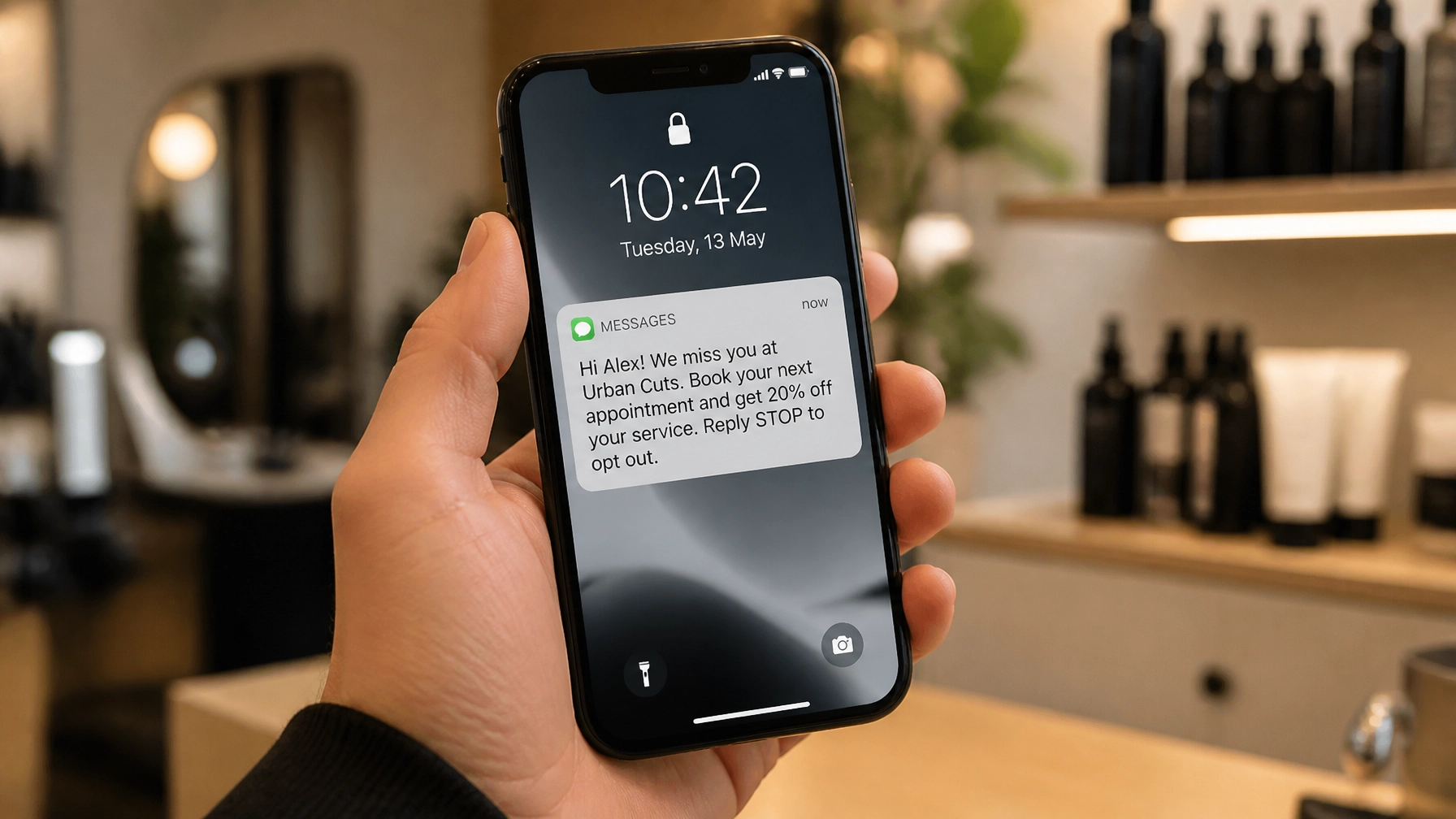
What you should not do is default to whatever channel is easiest for you. Many business owners default to email because they already have a Mailchimp account and feel comfortable there. If your business is service-based and your past customers book appointments, you are leaving money on the table by not using SMS.
What to Expect: 10-20% Reactivation
Here’s where most articles get vague. We’re going to stay specific.
A well-built reactivation campaign sent to a list of past customers who haven’t been contacted in six or more months typically produces a 10-20% response rate. That’s customers who take the action (book, buy, reply, redeem the offer) within the 14-day window.
The variance depends on a few things:
- How long since their last purchase. Three months out: response rates closer to 20%. Two years out: closer to 5%.
- How clean the list is. Bad phone numbers, dead email addresses, and customers who moved away all drag the rate down.
- Industry. Hair, auto repair, and dental tend to land in the 15-20% range. Specialty retail and one-off services tend to land in the 8-12% range.
- Offer strength. A meaningful discount or a genuinely useful piece of value beats “we miss you” with no incentive.
For planning purposes, use 10% as your conservative estimate and 20% as your optimistic one.
On a list of 200 past customers, that’s 20 to 40 returning clients from a single 14-day campaign.
The Math
Let’s run the numbers on what 20 returning customers actually means for a Kingsville, Ontario business.
Assume an average transaction value of $150. That’s reasonable for a hair salon, an auto repair visit, a dental cleaning, a mid-sized retail purchase, or a service call.
20 customers × $150 = $3,000 in revenue from one campaign
If you hit the upper end of the response range:
40 customers × $150 = $6,000 in revenue from one campaign
Now consider the cost side. An SMS campaign through a platform like Twilio, EZ Texting, or a CRM with built-in messaging costs roughly $0.02 to $0.05 per message. Three messages to 200 customers is 600 sends. At $0.05 per message, that’s $30 in send costs. Email is even cheaper, often free at this list size.
Set-up time, if you build it yourself, is 2-4 hours. If you have someone else build it, budget $300-$800 for a one-time setup that you then own and can re-run.
The return on a $30 campaign that produces $3,000 in revenue is not subtle. It is the highest-ROI marketing activity available to most small businesses, and it sits there unused because nobody scheduled it.
There’s also the second-order effect. A customer reactivated today is more likely to buy again in 90 days than a stranger acquired today. You’re not just earning $150 from Sarah this month. You’re putting Sarah back into the active customer pool, where she’ll see your next quarterly campaign, your seasonal promotion, your referral program. Lifetime value compounds in a way that one-shot campaigns don’t capture.
Making It Repeatable: Run It Quarterly
A reactivation campaign is not a one-time event. The list refills constantly. Customers who bought from you in March go quiet by September. Customers who came back during your spring campaign go quiet by fall.
The fix is to run the campaign on a calendar, not on a whim.
Quarterly is the right cadence for most businesses. Every 90 days, pull the list of customers who haven’t transacted in the last 90-180 days and run the 14-day sequence. Some businesses, particularly those with longer purchase cycles (HVAC, roofing, major automotive work), can run it semi-annually. Some with shorter cycles (restaurants, coffee shops, fitness studios) can run it monthly. But quarterly is the safe default.
Once the campaign is built, running it again is almost free. You’re not redesigning the messages. You’re not rethinking the structure. You’re swapping in the current list, updating the dates, and sending. The whole second-run setup takes 30 minutes.
Four campaigns a year, each producing $3,000-$6,000 in revenue from a 200-customer list, is $12,000-$24,000 in annual revenue from an asset you already own. For a Windsor-Essex business doing $300,000 a year in revenue, that’s a 4-8% lift from one repeatable system.
And the list keeps growing. Year two, your past-customer list is 400 names. Year three, 600. The same campaign mechanism produces more revenue every year without you doing more work.
What Stops Most Businesses From Running This
The campaign is simple. The math is obvious. The tools are cheap. So why doesn’t every business do this?
A few reasons come up over and over:
- The list is scattered. Customer data lives in a POS, a booking app, a spreadsheet, an old email tool, and three Post-it notes. Pulling a clean list feels like a project, so it never happens.
- The owner doesn’t know which platform to use. SMS platforms, email platforms, CRMs. The choice paralysis kills momentum before the first message is written.
- The first message feels awkward. “What if customers think we’re being pushy?” In practice, that almost never happens. Customers who don’t want to hear from you unsubscribe. Customers who forgot you exist are grateful for the reminder.
- No one owns the project. The owner is busy. Staff aren’t tasked with it. Quarterly becomes annually becomes never.
The businesses that solve these four problems consistently outperform their competitors on retention, and retention is where the margin lives.

Putting It Together
If you have a list of 100 or more past customers and you haven’t contacted them in the last six months, you have a sitting opportunity. Three messages, 14 days, a clear offer, and a real deadline. Quarterly cadence. SMS for service, email for retail.
The expected return on a 200-customer list is $3,000 to $6,000 per campaign, repeatable four times a year. The setup cost is hours, not weeks. The technical complexity is low.
The hard part is doing it instead of meaning to do it.
Get a Win-Back Campaign Built for Your Business
Doorways Into Your Business builds reactivation campaigns for small and medium businesses across the Windsor-Essex region. We pull your customer list, design the three-message sequence around your offer and your industry, set up the SMS or email automation, and hand you a system you can re-run every quarter.
If you’re sitting on a list of past customers and you know there’s revenue in there you’re not capturing, book a free consultation at https://blog.diyb.ca/contact-diyb. We’ll look at the list, run the projected math for your average transaction value, and tell you exactly what a campaign would be worth before you commit to anything.