
You've spent an hour writing an email campaign. Good subject line. Clear offer. Sent to your whole list.
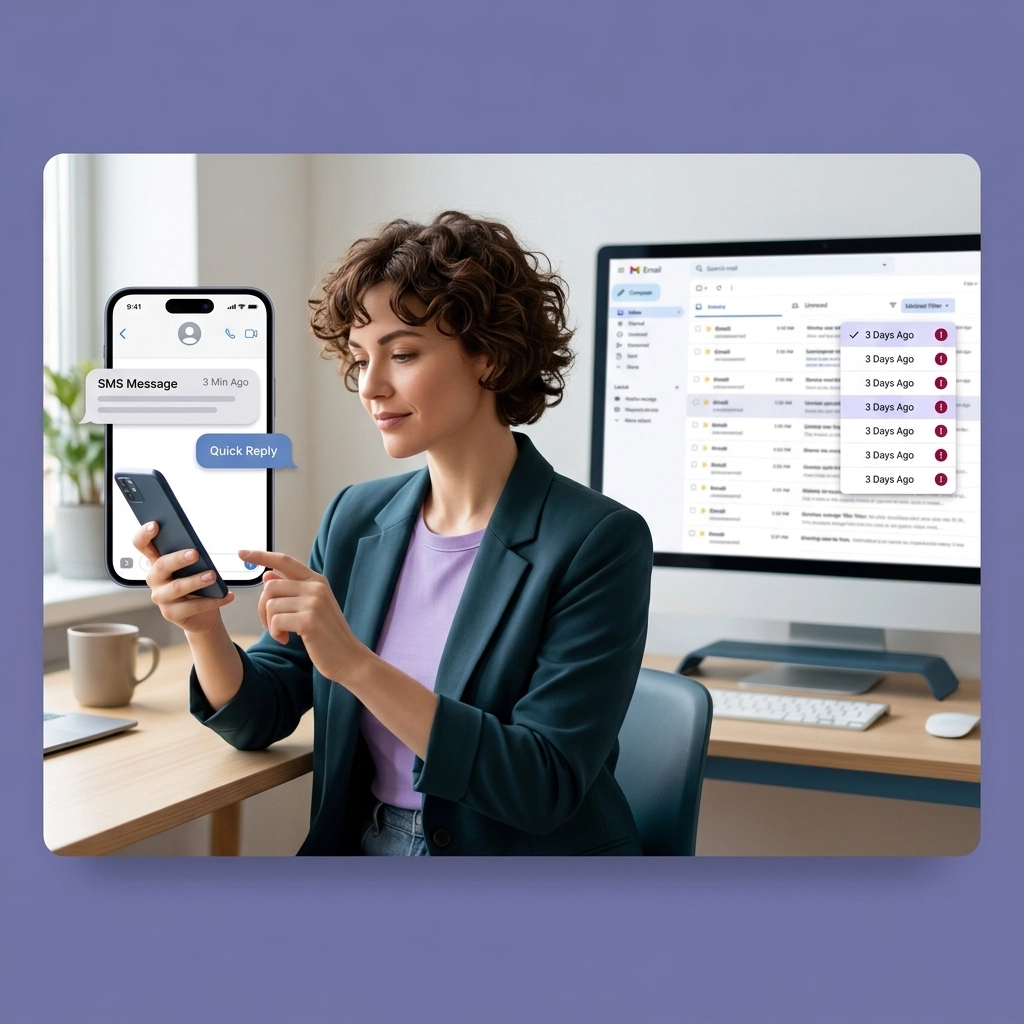
Three days later, 80% of your customers haven't opened it.
Meanwhile, the text message you sent last Tuesday about your flash sale? Customers were responding before you finished your coffee.
This isn't a coincidence. The numbers tell a clear story, and once you see it, it's hard to unsee.
The Numbers Are Not Close
Email marketing gets credit it probably doesn't deserve. The industry benchmark for email open rates sits around 20%, and most of those opens happen 24 to 48 hours after you hit send. Response rates land around 6%. Meaning: for every 100 emails you send, roughly 6 people do anything at all.
SMS marketing looks completely different:
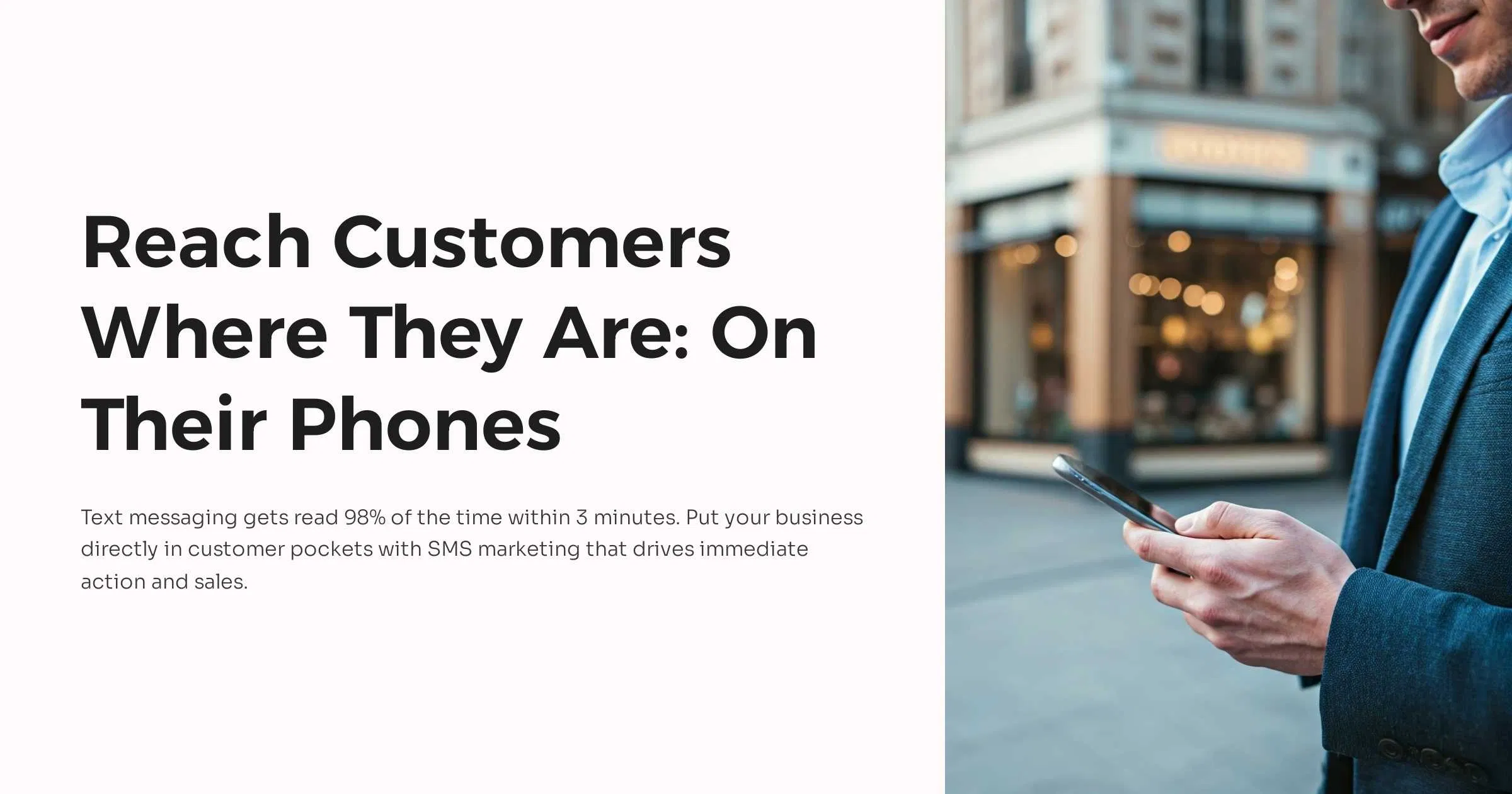
- 98% open rate on text messages
- 90% of texts are read within 3 minutes of delivery
- 45% response rate on SMS campaigns
That's not a small gap. That's a different category of communication.
The reason is simple. People don't have notification fatigue around text messages the same way they do with email. Most people's inboxes have hundreds of unread messages. Their text thread has a few. When a text arrives, they check it. Almost always. Almost immediately.
For local businesses where timing is everything, that difference changes what's possible.
Why This Matters Specifically for Local Businesses
National brands can afford to play the long game. They send email campaigns targeting behaviour over weeks. They have retargeting budgets and remarketing funnels. A 20% open rate over 48 hours is acceptable when you're operating at scale.
Local businesses don't work that way. Your timing windows are shorter and more specific.
A restaurant with empty tables at 5:30 PM needs responses in 20 minutes, not 2 days. A salon with a Tuesday cancellation needs to fill that slot before Tuesday, not whenever someone gets around to checking their inbox. A retailer running a one-day sale needs people to see it on the day.
Email can't do any of those jobs well. SMS can do all of them.
The time-sensitive nature of local business, the appointment economy, the flash offers, the last-minute inventory, the seasonal pushes, these are exactly the conditions where SMS marketing earns its keep.
What SMS Marketing Looks Like in Practice
A lot of business owners imagine SMS marketing as blasting discount codes to everyone in their phone list. That's one version of it, and not the most effective one. The businesses getting real results from SMS are using it more precisely.
Appointment reminders. Send a reminder 24 hours out and another 2 hours before. No-show rates drop significantly. This alone often pays for whatever SMS platform you're using.
Review requests. After a completed job or appointment, a short text asking for a Google review outperforms email by a wide margin. The read is immediate, the ask is simple, and the friction is low. If you want to understand why reviews matter so much for local businesses, the strategy behind this connects directly to what we cover in Your Best New Customer.
Flash offers and last-minute specials. Tuesday afternoon is slow? A text to your opted-in list about a same-day special moves the needle in a way an email blast cannot.
Follow-up after purchase. A short text a few days after a transaction, asking if everything went well, is a customer experience move that costs almost nothing and builds loyalty.
Delivery and status notifications. If your business involves any kind of order, service, or pickup, text updates keep customers informed and reduce the "where is my stuff" call volume.
Each of these is a short, useful message that arrives when it's relevant. That's the whole model.
When to Use SMS and When to Use Email
This is not an argument for abandoning email. Both channels have legitimate roles. The key is understanding what each one is built for.
Use SMS when:
- The message is time-sensitive (same-day offers, appointment reminders, urgent updates)
- The required action is simple (confirm, reply yes, click one link)
- You need to guarantee the message gets seen
- The content can be communicated in 160 characters or less
Use email when:
- The content is longer or requires context (newsletters, detailed proposals, product education)
- You're nurturing a lead over time rather than prompting immediate action
- You need to include images, formatted layouts, or multiple links
- The reader should save the message for reference
Think of SMS as your phone call replacement for quick, important things. Think of email as your direct mail replacement for thorough, non-urgent content. Using SMS for what email is bad at, and email for what SMS is bad at, is where local businesses find their rhythm.
If you're already running simple SMS marketing campaigns alongside your email efforts, you're likely seeing exactly this dynamic play out.
Building Your SMS List the Right Way
Before anything else: consent is mandatory, and in Canada, CASL (Canada's Anti-Spam Legislation) governs commercial electronic messages, including texts. You need express consent before you can send marketing SMS to a Canadian number. This means someone has to actively agree, not just give you their number for a service transaction.
The good news is that building a compliant list is straightforward when you build consent into your normal touchpoints.
At checkout or booking: Add a simple checkbox or verbal opt-in. "Can I send you text updates on specials and reminders?" Most customers who trust you will say yes.
On your website: A short form offering a first-purchase discount or booking reminder in exchange for a phone number and opt-in works well. Keep the offer specific.
On your receipts or invoices: A short note with instructions to text a keyword to your number ("Text DEALS to [number] for exclusive offers") is a low-friction opt-in that works over time.
At your physical location: A small sign near the register or front desk with a simple opt-in instruction catches customers who are already engaged.
A few practical rules for compliance and list health:
- Always identify your business name in every message
- Include a simple opt-out option in every campaign ("Reply STOP to unsubscribe")
- Never purchase phone number lists
- Keep records of how and when consent was given
- Don't send messages outside reasonable hours
A smaller list of genuinely opted-in customers will outperform a large purchased list every time. The quality of consent predicts the quality of response.
The Cost Comparison
SMS platforms typically charge per message, or through monthly tiers based on message volume. Common pricing in Canada runs between $0.01 and $0.05 per outgoing SMS, with most small business plans landing in the $20 to $75 per month range for a few hundred to a few thousand messages.
Email platforms charge by subscriber count. A list of 1,000 subscribers on a standard platform costs roughly $10 to $20 per month. A list of 5,000 might cost $50 to $100.
On paper, email looks cheaper per contact. But when you factor in what actually produces a result:
| Channel | Cost per 1,000 messages sent | Expected responses (at benchmark) | Cost per response |
|---|---|---|---|
| ~$10 to $20 | ~60 (6%) | ~$0.17 to $0.33 | |
| SMS | ~$10 to $50 | ~450 (45%) | ~$0.02 to $0.11 |
The comparison flips when you measure cost per actual response rather than cost per message sent. SMS is delivering 7 to 8 times more responses per campaign, and the cost per real action is lower even when the per-message rate is higher.
For a local business running appointment reminders and preventing no-shows, a single recovered appointment can pay for a month of SMS platform costs. The math is usually not complicated.
The First 3 SMS Campaigns Every Local Business Should Run
Start here. These three campaigns are repeatable, low-risk, and produce visible results fast enough to validate the channel before you invest more heavily.
Campaign 1: The Appointment Reminder Sequence
Set up a 2-message sequence for every booking. One message 24 hours before, one 2 hours before. Keep both short:
"Hi [Name], this is a reminder of your appointment at [Business] tomorrow at [Time]. Reply CONFIRM to confirm or call us at [number] to reschedule."
Track your no-show rate before and after. Most businesses see a 20 to 40% reduction in no-shows within the first month. That's revenue that was previously disappearing.
Campaign 2: The Post-Visit Review Request
One to two days after a completed appointment or purchase, send a single message asking for a Google review:
"Thanks for visiting [Business] this week. If you have a minute, a Google review helps us a lot: [link]. Reply STOP to opt out."
Keep it genuine. Keep it simple. The timing matters, 24 to 48 hours post-visit catches customers while the experience is fresh. This is one of the most cost-effective ways to build your Google review count, which directly affects how new customers find you. The full picture on why that matters is covered in Your Best New Customer.
Campaign 3: The Reactivation Offer
Pull a list of customers who haven't visited or purchased in 90 days or more. Send one targeted message with a specific, time-limited offer:
"Hey [Name], we haven't seen you in a while at [Business]. Come back this week and get [specific offer]. Valid until [date]. Reply STOP to unsubscribe."
Don't make the offer vague. "Come back for a discount" lands worse than "Come back this week for 20% off your next service." Specificity drives action.
Run this once per quarter on your dormant list. The reactivation rate won't be huge, but recovering even 5 to 10 customers per quarter from a list that was otherwise doing nothing has a real dollar value.
The Channel Your Competitors Aren't Using
Most local businesses in your area are running the same email strategy and wondering why it feels like shouting into a void. SMS marketing adoption among small businesses is still low enough that being one of the first in your category to use it well is an actual competitive advantage.
The 98% open rate isn't a trick. It's a reflection of how people actually use their phones. Text messages are personal, immediate, and visible. For a local business trying to stay top of mind, fill slow days, reduce no-shows, and earn more reviews, that immediacy is exactly what you need.
The window to get ahead of this channel won't stay open indefinitely.
If you want to set up SMS marketing for your business, including the right platforms, opt-in flows, and a campaign sequence built for your specific type of business, book a free consultation with Paul Hughes at Doorways Into Your Business: https://blog.diyb.ca/contact-diyb.