
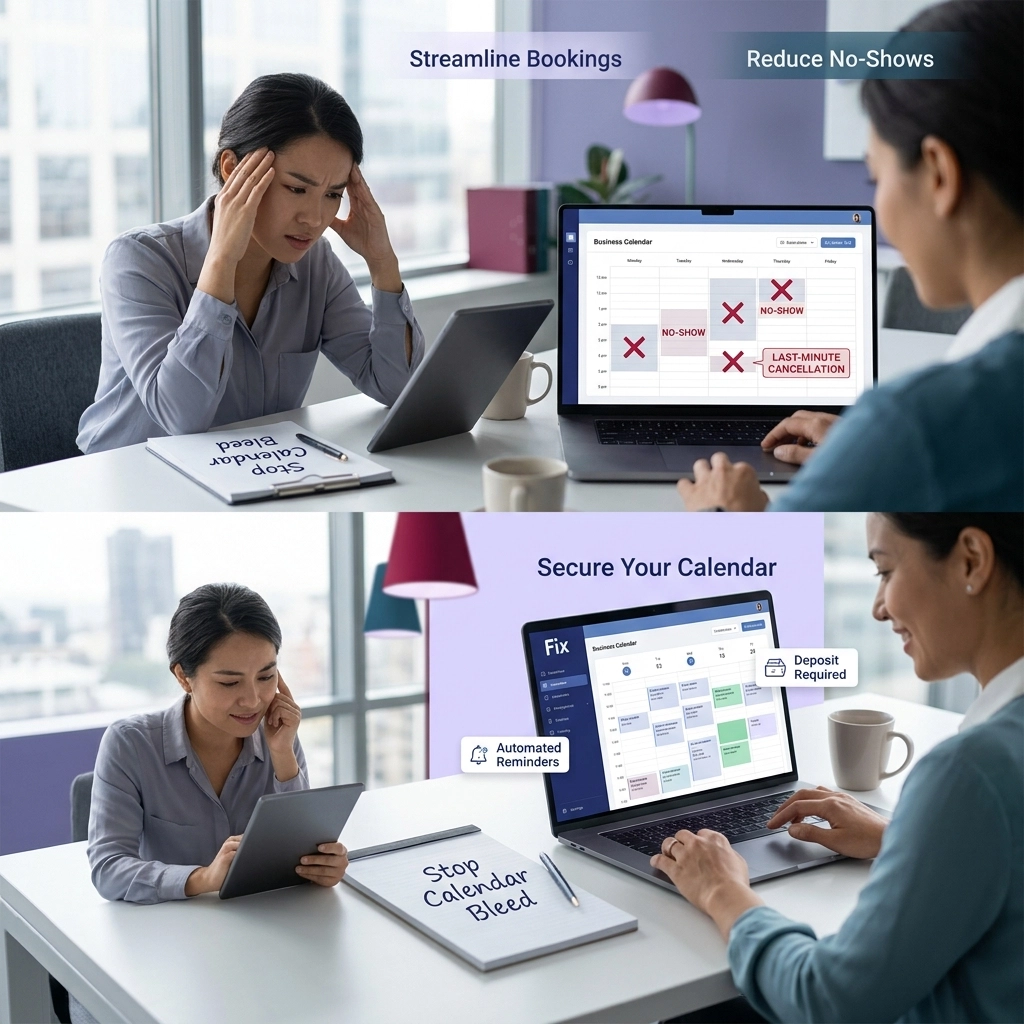
Book 20 appointments a week. Lose 15% to no-shows. That's 3 empty slots sitting on your calendar every single week, each one representing a client who consumed your time, blocked a spot someone else could have taken, and then simply didn't show up.
At $75 per appointment, those 3 slots cost you $225 a week. Multiply that across 52 weeks and you're looking at $11,700 a year walking out the door before you've done a single minute of work.
That number doesn't include the indirect costs: the scheduling scramble, the awkward follow-up call, the mental overhead of not knowing whether to hold the slot or release it. No-shows are expensive in ways that don't show up on a profit and loss statement.
The good news: this is a solvable problem. Most no-shows don't happen because people are inconsiderate. They happen because the booking process gave them no reason to feel committed.
Why People No-Show
Understanding the cause determines the fix. No-shows typically fall into 4 categories:
- They forgot. Life is busy. An appointment booked 3 days ago is easy to lose in the shuffle.
- Something came up. Legitimate conflicts arise. Without a simple way to reschedule, some clients default to not showing.
- They booked someone else. If another provider sent a timely reminder and yours didn't, you're the one who loses the appointment.
- They didn't feel committed. This is the big one. A booking made without any confirmation exchange feels disposable. No paper trail, no psychological ownership.
The first two are manageable with the right reminder sequence. The fourth is solvable with basic behavioral psychology. The third is a competitive reality: your reminder system is part of your client experience whether you've built one or not.
The Reminder Sequence That Works
A 4-touch sequence handles the vast majority of no-show scenarios without requiring manual effort from you or your staff.
Touch 1: Confirmation at Booking
The moment a client books, they receive a confirmation with the date, time, service, and location. This isn't just a receipt. It's the first commitment anchor. They see the details in writing, and that small act of reading them increases psychological ownership of the appointment.
Include a link to reschedule here. Counterintuitive as it sounds, making it easy to change an appointment reduces no-shows. Clients who can't easily reschedule often just disappear.
Touch 2: 24-Hour Reminder (Text)
The day before the appointment, a text reminder goes out. Short, specific, and actionable:
"Hi Sarah, just a reminder about your appointment at [Business Name] tomorrow at 2:00 PM. Reply YES to confirm or visit [link] to reschedule."
That reply YES matters. We'll come back to that.
Touch 3: 2-Hour Reminder (Text)
A second text the morning of, or 2 hours before the appointment. At this point, the client is already planning their day. A brief reminder keeps the appointment front of mind and catches anyone who forgot despite the first text.
Touch 4: Easy Reschedule Link
Every reminder should include a reschedule link. Every single one. This removes the barrier that turns "I need to move this" into "I just won't show up." When rescheduling is harder than disappearing, clients choose disappearing.
Why Text Beats Email
Email open rates for appointment reminders run around 20%. That means 8 out of 10 email reminders don't get read.
Text messages sit at 98% open rate, and most are opened within 3 minutes of delivery.
This isn't a minor difference. It's the difference between a reminder system that works and one that exists on paper but fails in practice. If your reminders are going out by email only, you're reaching roughly 1 in 5 clients. The other 4 are flying blind into an appointment they may have half-forgotten.
Text reminders don't require an inbox check, don't compete with promotional emails, and don't get caught in spam filters. They show up on the screen people check constantly. For time-sensitive communication like appointment reminders, there is no realistic substitute.
The Psychology of Commitment
Behavioral research consistently shows that when people articulate a commitment, they're more likely to follow through on it. A booking confirmation that asks the client to reply YES isn't just a logistical check. It's a commitment device.
Clients who confirm via text reply are approximately 80% less likely to no-show than those who receive a passive reminder with no response required. The act of replying creates a small but meaningful psychological contract. They've now said they'll be there. Breaking that commitment carries more weight than ignoring a notification.
This is the difference between sending a reminder and building a confirmation loop. The loop works. Passive reminders are better than nothing. The confirmation loop is the actual solution.
For a broader look at how automated follow-up systems protect your revenue across multiple touchpoints, see Stop Playing Phone Tag: How Automated Follow-Up Wins Back Lost Leads.
Setting Up the System
The barrier most service businesses cite for not having a reminder system is setup cost and complexity. Neither holds up to scrutiny.
An automated text reminder system with booking confirmation, 24-hour and 2-hour texts, and reschedule links typically runs $50 to $150 per month depending on the platform and volume of appointments.
Using the numbers from the opening of this article, that system pays for itself with 1 recovered appointment per month. After that, every no-show you prevent is pure recovered revenue.
The math on a properly configured system is rarely close. For a business running $11,700 in annual no-show losses, a $100/month reminder system that cuts that figure by 60% recovers roughly $7,000 per year. The system costs between $1,200 and $3,600 per year.
Most service businesses recoup the investment inside 30 to 90 days.
The setup itself takes a few hours to configure properly: connect your booking software, write the message templates, set the trigger times, test the sequence. Done once, it runs without ongoing attention. You get notified when clients confirm, cancel, or request a reschedule. The calendar stays accurate without manual follow-up calls.
The Real Cost of Doing Nothing
Every week you run without a reminder sequence is another week absorbing avoidable losses. The clients who no-show aren't the problem. The absence of a system that keeps them committed is.
The sequence isn't complicated. Confirmation at booking, 24-hour text, 2-hour text, easy reschedule link, and a reply confirmation to trigger the commitment loop. That's the whole thing.
The question isn't whether the system works. The question is how much you've already left on the table without it.
Ready to Stop Losing Appointments?
Doorways Into Your Business sets up automated appointment reminder systems for service-based businesses across Essex County and beyond. If no-shows are costing you revenue, book a free consultation and we'll show you exactly what a working system looks like for your business.
Book your free consultation at https://blog.diyb.ca/contact-diyb