

You finished the job. The work is done, the customer is happy, and you head home feeling good about the day. Then you send the invoice.
And then you wait.
Thirty days pass. Nothing. You send a polite reminder. Another two weeks go by. You're now in the awkward position of being part debt collector, part contractor, and you're spending mental energy on money that's already yours by every reasonable measure. Meanwhile, your supplier wants to get paid. Your fuel costs don't pause. Your crew expects their cheques on schedule.
This is the invoice chase, and if you run a local service business, you already know exactly what it costs you.
The Cash Flow Problem Nobody Likes to Talk About
Late payments are the leading cash flow killer for small and medium service businesses. A 2019 survey by Intuit found that 69% of small business owners reported that late payments had kept them up at night. In Canada, the average small business waits 72 days to collect on invoices, against standard 30-day terms that were already optimistic.
The math is brutal. You finish a $4,000 job. That money is sitting in someone else's account for 60 days while you cover your costs out of pocket. Multiply that across 5 or 10 active jobs and you can be owed $30,000 while technically running at a loss for the month.
This isn't a bookkeeping problem. It's a structural problem in how most trades and service businesses handle payment. The good news is that it's solvable, and the tools to solve it are already in your pocket.

What Mobile Payment Solutions Actually Do
The shift from "send an invoice and hope" to "get paid on the spot" comes down to infrastructure. Modern mobile payment tools handle the full collection cycle, and they're built for exactly the kind of work contractors and tradespeople do.
Tap-to-Pay at Job Completion
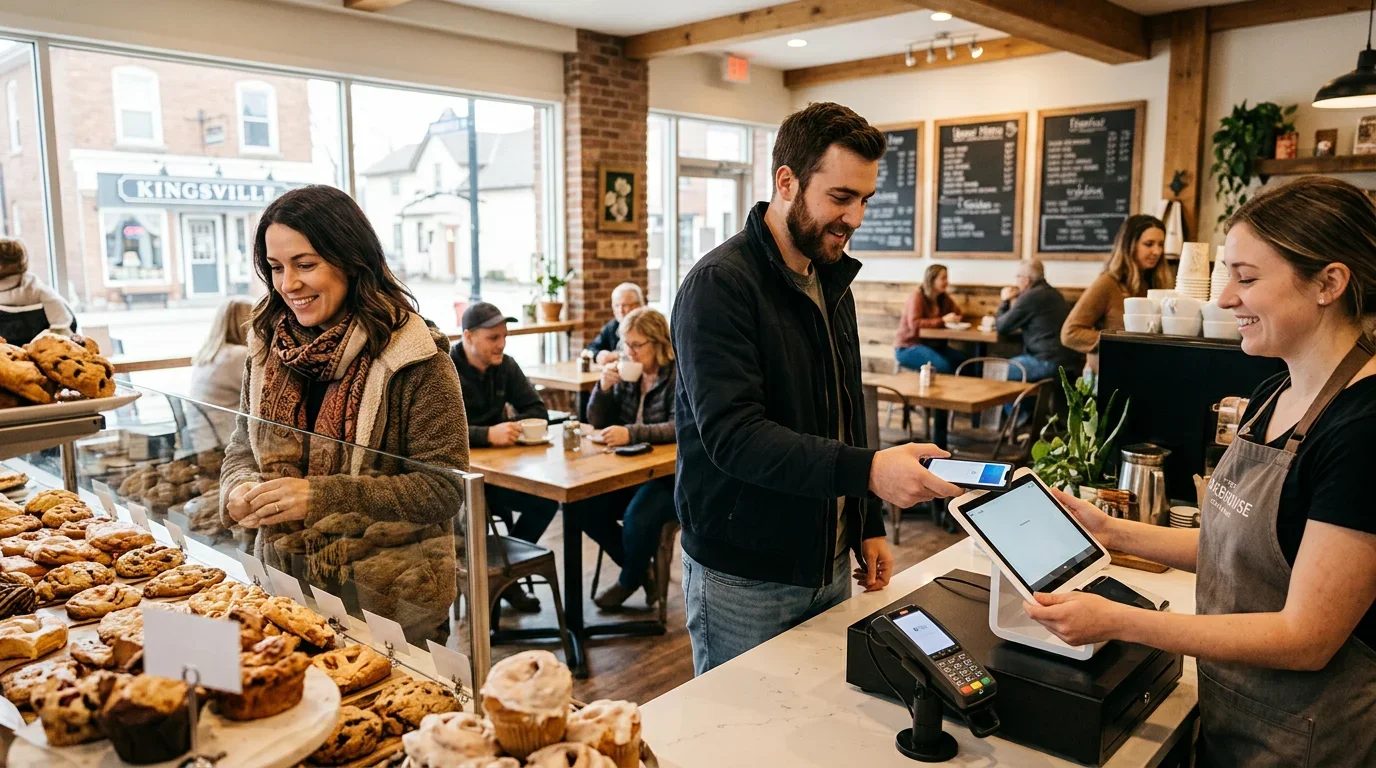
Square, Stripe, and similar platforms let you take card payments on a phone or tablet the moment you close out a job. A small card reader or an NFC-enabled device means a customer can tap their card or phone on the spot, the same way they'd pay at any retail counter. No delay. No invoice sitting in an inbox.
Digital Invoices with Pay-Now Links
When a face-to-face payment isn't practical, the next best tool is a digital invoice with an embedded payment link. The customer receives the invoice by email or text, sees a clear total with your business name and logo, and clicks one button to pay. Many platforms process these payments in under 2 minutes. The barrier between "invoice received" and "invoice paid" drops to nearly zero.
Automatic Payment Reminders
If an invoice does go unpaid past a due date, automated reminders fire on a schedule you set. No awkward phone calls. No manual follow-up emails where you second-guess your wording. The system handles it.
Recurring Billing for Ongoing Clients
If you have maintenance contracts, monthly service agreements, or retainer clients, recurring billing automates the entire cycle. The client authorizes payment once, and you collect automatically on schedule. Cash flow becomes predictable instead of a guessing game.
Why Customers Pay Faster When You Ask at the Right Moment
There's a psychology at work here that's worth understanding.
The moment a customer is most satisfied with your work is the moment you finish it. They've just watched you solve their problem. The driveway is sealed. The bathroom is tiled. The HVAC is running quietly. That positive feeling peaks right there.
Two weeks later, when your invoice arrives, the satisfaction has faded. The problem you solved no longer feels urgent. Now your invoice is competing for attention alongside six other bills and two other contractors they hired last month. Customers don't become less honest, but they do become less motivated.
Asking for payment at job completion, when the work is fresh and the value is visible, converts at a dramatically higher rate than sending an invoice later. One study by PaySimple found that businesses using on-site payment collection reduced their average days-to-payment from 37 days to under 4. The service didn't change. The timing did.
What a Professional Invoice Actually Looks Like
Getting paid on the spot doesn't mean handing someone a handwritten receipt. Professional invoicing matters even when the turnaround is immediate, because it protects you legally, builds trust, and makes your business look credible.
A strong invoice includes:
- Your business name and logo at the top
- Client name and job address
- Clear line items for labour, materials, and any additional charges, described plainly
- Payment terms stated explicitly ("Payment due on receipt" if that's your model)
- A direct payment link or QR code if the invoice is going out digitally
- Your contact information in case the client has questions
Line items matter more than most contractors realize. A single-line invoice that says "$1,400 for work" invites questions and disputes. An invoice that breaks out 8 hours of labour at $95/hr and $660 in materials at actual cost tells a clear story. There's less room for "can you explain this charge?" and less friction before payment.
What to Look for When Choosing a Payment Platform
Not all mobile payment tools are built the same. Before committing to a platform, evaluate it across these dimensions:
Transaction fees. Most platforms charge between 1.5% and 2.9% per transaction, plus a small flat fee per swipe or tap. Know what you're actually paying on a typical job size. A 2.9% fee on a $5,000 invoice is $145. That's a meaningful cost, and some platforms offer lower rates for higher-volume accounts.
Deposit speed. Standard deposits take 1 to 2 business days. Some platforms offer same-day or instant transfers for a small additional fee. If cash flow is tight, that option matters.
Invoice customization. Can you add your logo? Customize line items? Set automatic payment terms? A system that forces generic invoices won't reinforce your brand.
Bookkeeping integration. Platforms that sync with QuickBooks, Wave, or FreshBooks save hours of manual data entry and keep your records clean for tax time. This is a quality-of-life feature that becomes a major efficiency gain at scale.
Customer support. When a payment doesn't process or a client disputes a charge, you need a platform that picks up the phone or responds quickly. Check reviews before you commit.
The Ripple Effect of Getting Paid Faster
Faster payment isn't only about avoiding stress. It changes what you can do.
When cash comes in on the day work is completed, you can take on more jobs without borrowing against the next one to cover the current one. You can pay suppliers faster and sometimes negotiate better rates. You can build a reserve that lets you weather a slow month without the panic. You can give crew members predictable, reliable pay.
The businesses that grow steadily in the trades and service sector aren't always the ones with the most clients or the best marketing. They're often the ones that don't have cash tied up in unpaid invoices. They have working capital to act on opportunities when they appear.
Getting paid on the spot is operational discipline. It closes the loop between work delivered and money received, and it keeps that loop tight. Every day an invoice sits unpaid is a day you're financing someone else's cash flow with your own.
You don't have to run your business that way.
Paul Hughes at Doorways Into Your Business helps local service businesses set up mobile payment systems, digital invoicing, and automated follow-up so you get paid faster without chasing anyone. Book a free consultation at https://blog.diyb.ca/contact-diyb and let's build a payment setup that works as hard as you do.