
Your phone rings while you’re with a customer in Kingsville, Ontario, under a vehicle, mid-cut, or elbow-deep in a plumbing job. You can’t answer. Thirty seconds later, it stops.
That’s it. No voicemail left. No callback number. No second chance.
That caller is already scrolling to the next result.
This is the default outcome for missed calls at most small businesses. It happens dozens of times a week across the Windsor-Essex region without the owner ever noticing. There’s no alert, no log that flags missed opportunities, and no way to know how much revenue walked out the door because nobody picked up.
But that outcome isn’t fixed. There’s a simple system that changes what happens in those 30 seconds after a missed call. It recovers leads that would otherwise disappear permanently.
What Actually Happens When You Miss a Call
Most business owners assume missed calls leave voicemails. Most don’t. Studies consistently show that the majority of callers, especially younger customers, hang up rather than leave a message. They wanted a fast answer. A voicemail prompt is an obstacle. Hanging up feels like the easiest path forward.
So they hang up. Then they Google the same service, click the next listing, and call your competitor. If your competitor picks up, or even sends a fast text response, the job is gone.
The caller didn’t hate you. They weren’t loyal to anyone else. They just needed someone to respond, and you weren’t there. The business that responds first usually wins.
This plays out constantly in trades, salons, dental offices, auto shops, restaurants, legal practices, and any business that handles high call volume. If you’ve ever wondered why your phones are ringing but your calendar isn’t as full as it should be, missed calls with no follow-up are a major part of the answer.
If this pattern sounds familiar, the article That Phone Call Just Paid Your Competitor walks through exactly how this loss happens and what it costs over time.
![[HERO] The Automated Text That Saves a Missed Call - Providing Smart Digital Doorways for Kingsville and Windsor-Essex County](https://blog.diyb.ca/wp-content/uploads/2026/05/The-Automated-Text-That-Saves-a-Missed-Call_Q3dlgG_DGnK.webp)
What Could Happen Instead: The 30-Second Text
Now imagine a different outcome for that same missed call.
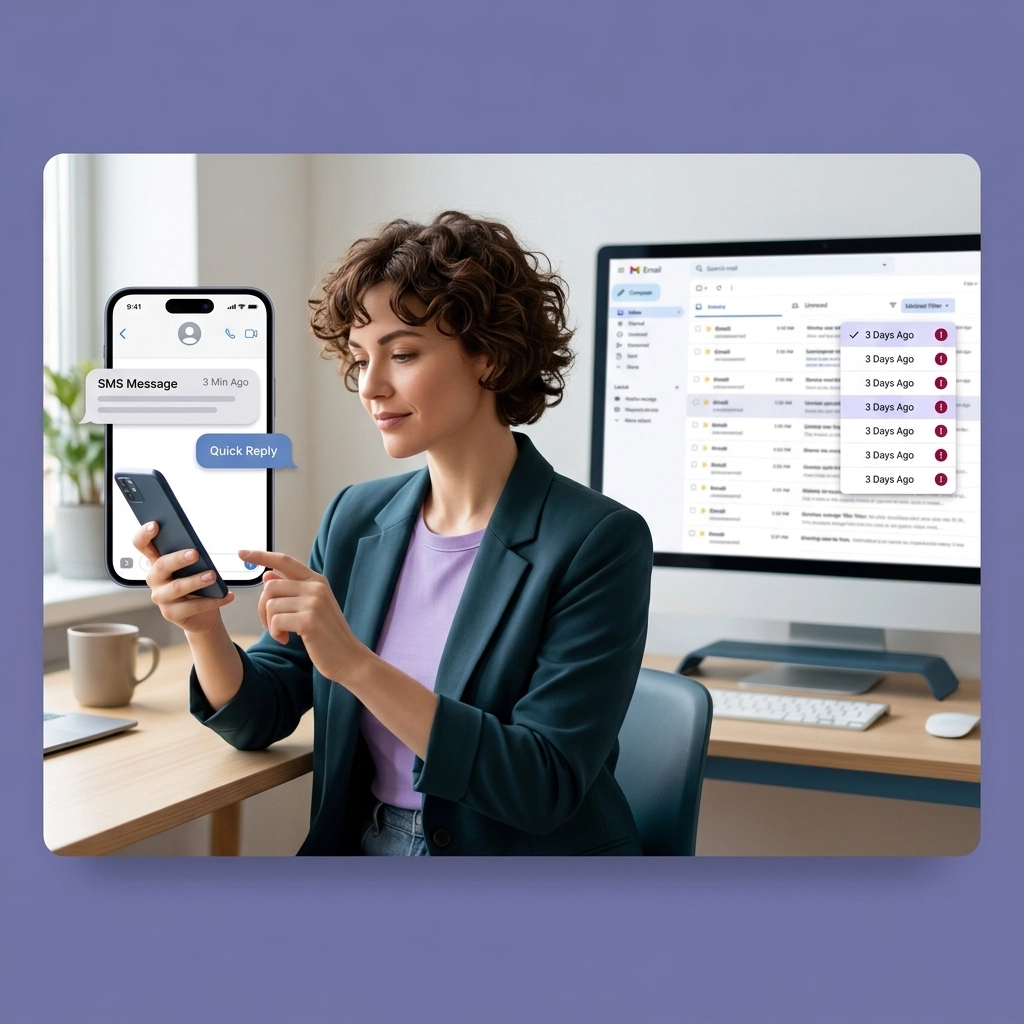
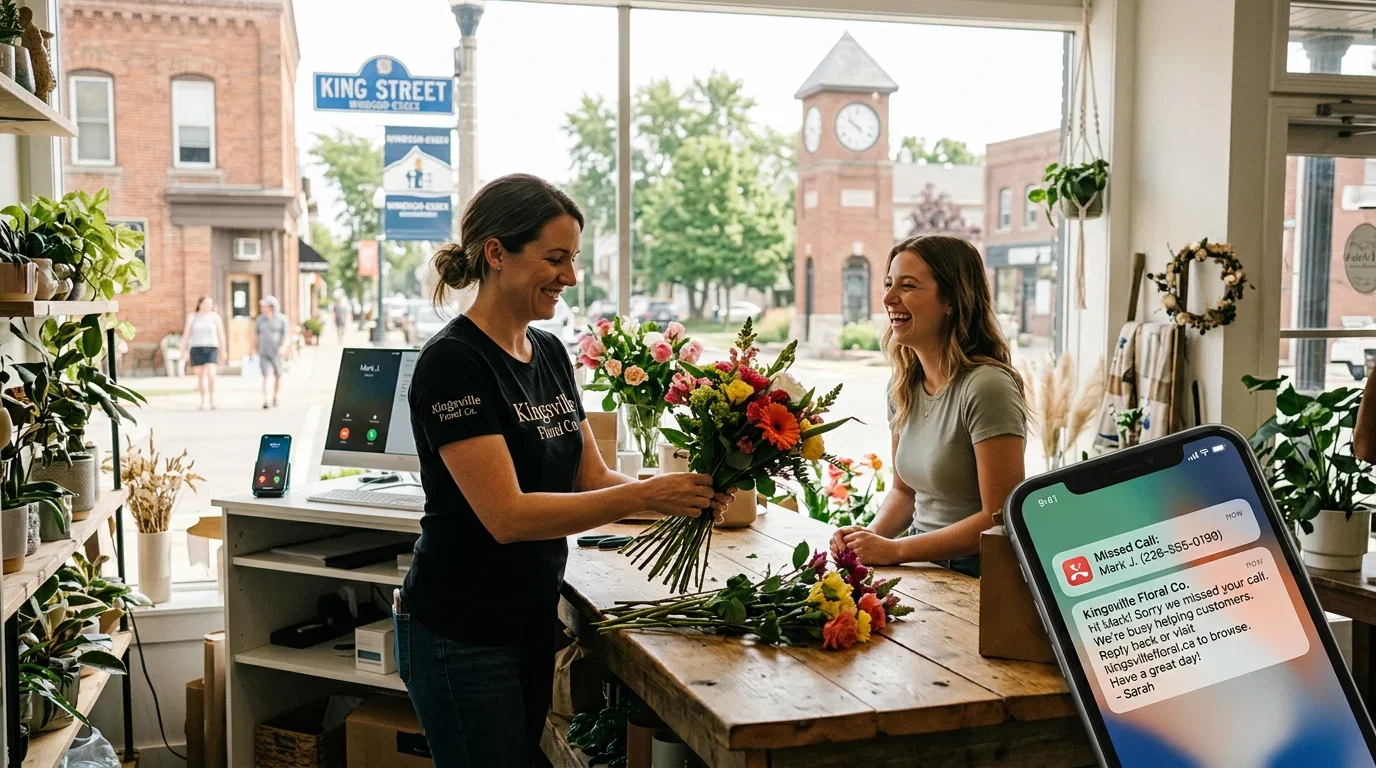
Your phone rings. You can’t answer. It stops after 4 rings. Within 30 seconds, the caller receives a text message:
“Hi, thanks for calling Lakeview Plumbing! Sorry we missed you. How can we help? We’ll get back to you right away.”
The caller is still holding their phone. They just tried to reach you. A personal, human-sounding message arriving in seconds feels like a response because it is one.
Instead of scrolling to the next Google result, they reply. “I need someone to look at a leaking pipe.” Now you have their number, their issue, and an open conversation, all from a call you didn’t pick up.
That’s what a missed-call text-back system does. It catches the window between “caller gives up” and “caller calls someone else” and keeps the lead alive.
How It Works Technically
The mechanics are straightforward. There is no complicated hardware and no changes to your existing phone system. We simply install a Smart Digital Doorway to manage the interaction.
When a call comes into your business line and goes unanswered after a set number of rings, the system detects that the call was missed. It automatically sends a pre-written SMS to the caller’s number. The message goes out within seconds. When the customer replies, you receive a notification and can continue the conversation from a web dashboard or your own phone.
The Three Components
1. Call detection. The system monitors your business phone number for unanswered calls. This works with landlines forwarded to a tracking number, VoIP systems, and mobile numbers depending on the setup.
2. Automatic SMS trigger. When a missed call is detected, the system fires a text to the caller’s number immediately. The message is customized in advance, so every caller gets a consistent, branded response.
3. Conversation routing. Replies come into a centralized inbox, a mobile app, or a CRM depending on the platform. You or your team respond from there, the customer sees your business name, and the conversation continues.
The caller never sees automation. They see a text from your business, arriving fast, asking how to help. The setup is typically done in a day. Maintenance is minimal once the message is written and the workflow is configured.
The Numbers: What Text-Back Systems Actually Recover
This isn’t theoretical. Businesses using missed-call text-back systems report recovering 30 to 50 percent of leads that would have been lost to no-answer situations. This is a core part of effective Lead Generation and Win-Back Systems.
Put that in terms of actual volume. If your business misses 20 calls a week, which is a conservative number for most small service businesses, that is 80 missed calls per month. At a 40 percent recovery rate, you are converting 32 of those callers into active conversations you wouldn’t have had otherwise.
Not all of those conversations become paying customers. But if even 10 of them book a job or make a purchase, and your average transaction is $200, that is $2,000 in recovered revenue per month from a system that mostly runs itself.
If you want a harder look at the pattern of lost customers behind these numbers, 3 Customers You Lost This Week Without Knowing It breaks down exactly who they were and where they went.
Writing a Message That Sounds Human
The message is everything. A clunky, robotic, or generic text undermines the whole point. If the first thing a caller receives sounds automated, it damages trust before any conversation starts.
A good missed-call text follows three principles. It uses your business name, it acknowledges the missed call directly, and it asks a question that invites a reply.
Structure of a Strong Message
Acknowledge the miss. Don’t pretend nothing happened. “Sorry we missed your call” is honest and sets a human tone.
Use the business name. “Thanks for calling Riverside Auto” is immediately more specific and trustworthy than “Thanks for calling us.”
Ask an open question. “How can we help?” or “What can we do for you today?” opens the door to a reply without pressure.
Keep it short. Under 160 characters is ideal. Long texts feel like form letters.
Examples by Industry
For a trades business: “Hey, thanks for calling Green Valley Electric. Sorry we missed you. What can we help with today? We’ll get back to you shortly.”
For a salon: “Hi! Thanks for calling Studio 9 Hair. Sorry we missed your call. Are you looking to book an appointment? We’d love to get you in.”
For a medical or dental office: “Thank you for calling Elmwood Family Dental. We’re sorry we missed you. Are you looking to book an appointment or do you have a question for our team?”
Each message sounds like a person wrote it and sent it. That is the goal. If someone reads the text and thinks “a real person sent this,” the message is working.
Beyond the First Text: What to Do When They Don’t Reply
Some callers won’t respond to the first text. That doesn’t mean they’re gone. They may be busy, they may be waiting to see if you follow up again, or they may have gotten sidetracked. A single follow-up at the right interval can recover a meaningful percentage of these non-responders.
A Simple 2-Step Follow-Up Sequence
Step 1: First text fires immediately after the missed call. This is the core recovery text described above.
Step 2: Second text fires 4 to 6 hours later if there’s been no reply. Keep this one brief and direct: “Just following up from earlier, still happy to help if you need anything. Just reply here or give us a call.”
That is the entire sequence for most businesses. Two touchpoints. Minimal friction. There is no aggressive follow-up cadence that feels like a sales campaign.
If you are running a higher-ticket service where leads have longer decision cycles, like roofing, HVAC, or renovation work, a third touchpoint 24 hours later can be worth adding: “We want to make sure you got the help you needed. Still happy to chat when the timing works.”
After 3 touchpoints with no response, stop. You’ve made a reasonable effort. Some callers were tire-kickers, wrong numbers, or handled their need another way. That is fine. The system is designed to catch the recoverable ones, and it has.
Cost vs. Value: What This Actually Costs You
Missed-call text-back systems typically run between $30 and $100 per month, depending on the platform, message volume, and whether the feature is bundled with other tools like a CRM, review automation, or two-way texting.
At the low end, $30 per month is $360 per year. At the high end, $100 per month is $1,200 per year.
Now consider this. If your average transaction is $300 and this system recovers even 4 leads in a full year, it has paid for itself at the $1,200 price point. For most businesses, it recovers far more than that within the first 90 days.
The Real Comparison
The alternative to a $30-100/month system is continuing to lose 50 to 70 percent of every missed call. For a business missing 20 calls per week, that is roughly 60 lost leads per month at zero recovery. If even 15 of those callers were ready to spend money, the cost of inaction is far higher than the cost of the tool.
This is not a marketing expense. It is recovery infrastructure. You have already paid for the marketing that generated the call. The lead exists. A text-back system captures what you have already earned.
Getting It Set Up
Setup is fast. Most businesses are running their first automated text within 24 hours of starting the process.
The steps are:
- Connect your business phone number to the system.
- Write your initial text message. Use the examples above as a starting point.
- Set the follow-up timing if you want a second touchpoint.
- Test it by calling your own number from another phone and watching the text arrive.
After that, the system runs without intervention. You’ll get notified when customers reply, and you handle those conversations the same way you’d handle any incoming text or message.
If you already use a CRM or scheduling system, most text-back platforms integrate with common tools like Google Calendar, Jobber, HubSpot, or ServiceTitan. Customer replies can flow directly into your existing workflow.
A Note on Expectations
Text-back systems do one specific thing well. They reopen conversations with people who called and didn’t get an answer. They are not a full customer communication strategy. They won’t fix a slow website, poor reviews, or a broken onboarding process.
But they solve a real and specific problem. A caller who gets a text within 30 seconds of hanging up is still engaged. That window is short. The system catches leads inside that window consistently, automatically, and without requiring you to be available 24 hours a day.
Every missed call used to be a guaranteed loss. With this system in place, it becomes a recoverable opportunity. The difference is a short text message that arrives before your caller reaches your competitor.
Start Recovering Missed Calls
If your business is missing calls and getting nothing back from them, Doorways Into Your Business can set up a missed-call text-back system that starts capturing leads within 24 hours. We build and install these systems specifically for local entrepreneurs in Kingsville, Ontario, and the Windsor-Essex region.

Book a free consultation at https://pxllnk.co/diyb-contact-us to see what recovery looks like for your business specifically. We help you craft solid foundations for your digital presence so you never miss a doorway to a new opportunity.