

A bad Google review lands in your inbox and your stomach drops. You read it twice. Maybe three times. Something tightens in your chest. You want to respond immediately, set the record straight, tell your side of the story.
Stop. Breathe. Do not type anything yet.
How you respond to a negative review matters more than the review itself. Get it right and you convert a problem into proof that your business handles adversity with professionalism. Get it wrong and 50 potential customers read your meltdown and quietly choose your competitor.
This article walks through the full response strategy: the psychology, the frameworks, the templates, and the hard lines you should never cross.
The Gut Reaction and Why It Costs You Customers
Business owners are emotionally invested in their work. That is a feature, not a flaw. But that same investment makes a harsh review feel personal, because it is personal. Someone is criticizing something you built.
The instinct is to defend. To correct. To explain what actually happened. And if the review is exaggerated or outright false, the instinct hardens into something closer to anger.
That reaction makes complete sense as a human being. It is a disaster as a business strategy.
When you respond defensively in public, you are not convincing the original reviewer. You are performing for every person who finds that review later while deciding whether to hire you. A sharp, argumentative response signals three things to that audience: you do not handle criticism well, the customer experience at your business might actually be a problem, and working with you could get uncomfortable if something goes wrong.
Even when you are right, arguing publicly makes you look wrong.
The goal of your response is never to win an argument. It is to demonstrate judgment, empathy, and competence to the people who have not made their decision yet.
Why Bad Reviews Are Not Always Bad
Before writing a single word, it helps to reframe what a negative review actually means for your business.
A perfect 5.0 star rating is statistically less trusted than a rating between 4.2 and 4.8. This is consistent across multiple consumer research studies. The logic is intuitive: a business with 200 reviews and a 4.6 average looks credible. A business with 12 reviews and a 5.0 average looks curated, which is another word for suspicious.
Customers know that no business operates flawlessly across every transaction. When they see a few negative reviews in a sea of positive ones, it confirms the positive reviews are real. The negative reviews become social proof by contrast.
What kills businesses is not a handful of 1-star reviews. It is a handful of 1-star reviews with no response, or worse, a defensive one.
There is also selection bias in who leaves reviews at all. Your happiest customers often say nothing publicly because they are busy living their lives. Your unhappiest customers are motivated.
This means the review record is always skewed toward the negative. Anyone reading your reviews knows that at some level. They are reading for patterns, not individual data points. One angry review surrounded by 40 thoughtful, positive ones tells a clear story: this business generally delivers.
The goal is not zero bad reviews. The goal is handling them so well that they work in your favor.
For strategies on building a stronger review base so negative reviews stay in proper proportion, see How to Ask for Reviews Without It Feeling Awkward. Implementing Smart Review Management can help automate this process.
The Response Framework: Acknowledge, Apologize, Act, Take It Offline
Every effective negative review response follows the same four-part structure. The execution changes based on the situation, but the architecture stays consistent.
Acknowledge
Start by showing you heard the person. Do not paraphrase their complaint in a way that sounds like you are disputing it. Simply confirm you are aware of their experience and that it matters to you.
This is not the same as admitting fault. Acknowledgment is recognition, not concession.
Apologize (If Warranted)
If the complaint has merit, say you are sorry. Mean it. Keep it simple. A genuine apology does not require a lengthy explanation of all the reasons things went sideways. The customer does not need your operational context. They need to feel heard.
If the complaint is unfair or inaccurate, you can still express regret that their experience did not meet expectations without agreeing with their characterization of what happened.
Act
Tell them what you are going to do, or what you have already done. This demonstrates that the complaint has a practical consequence. It signals to other readers that you take feedback seriously and that your business actually improves.
Take It Offline
End every response by inviting them to continue the conversation privately. Give a direct contact: a name, a phone number, an email address. This moves a potentially escalating public thread into a controlled environment where resolution is actually possible.
It also signals to other readers that you are not hiding behind a public forum. You are offering direct access.
Three Templates for Three Situations
The tone and framing of your response should match the nature of the complaint. Use these as starting points, not scripts. Adjust for your voice and the specific details.
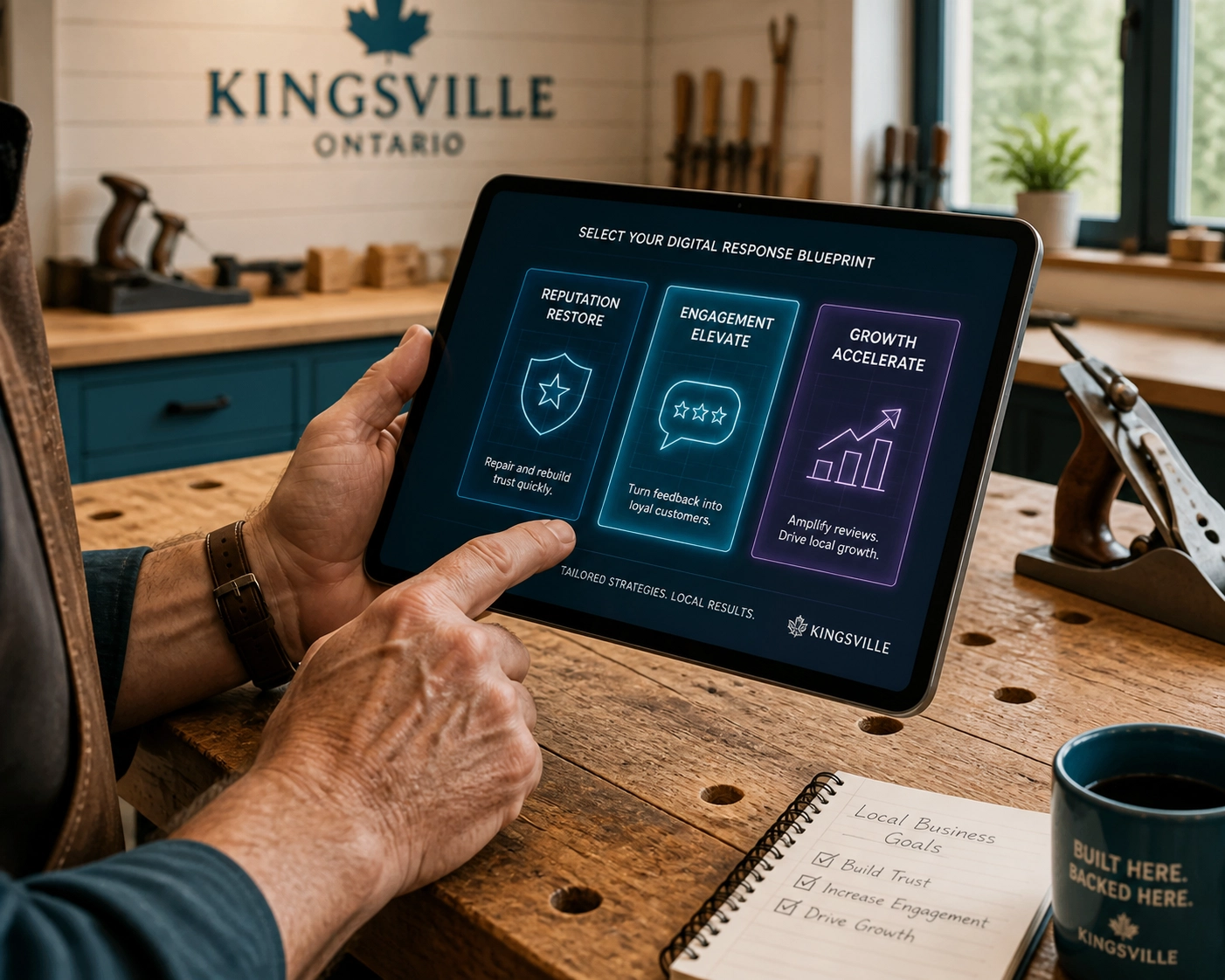
Alt: Responding to customer reviews in Kingsville, Ontario. Title: Online Review Response Templates for businesses in the Windsor-Essex region.
Template 1: Legitimate Complaint
Hi [Name], thank you for taking the time to share this. I am sorry your experience with us fell short of what we aim to deliver. You are right that [specific issue] should not have happened, and I take that seriously. We have [brief note on what has been addressed or is being addressed]. I would welcome the chance to speak with you directly. Please reach out to [name] at [phone/email] and we will make this right.
Template 2: Unfair or Exaggerated Complaint
Hi [Name], thank you for leaving feedback. I am sorry to hear your experience did not go the way you had hoped. Your account of what happened is a little different from our records of the interaction, but I do not want to debate that in a public forum. What I do want is to understand your perspective fully and see if there is anything we can do. Please contact me directly at [phone/email] and I will personally look into it.
Template 3: Suspected Fake Review
Hi [Name], we have searched our records and we cannot find any interaction with someone by this name. If you have had a genuine experience with our business, we would genuinely like to hear more about it and resolve any issue. Please reach out to [name] at [phone/email]. If this review was left in error, we hope you will consider removing it.
What Not to Say
Some responses are worse than the original review. Avoid every one of these.
Arguing the facts publicly. Even if you are factually correct, a tit-for-tat exchange reads as petty to every bystander. You cannot win this kind of argument in a public forum.
Blaming the customer. "You should have read the terms more carefully" or "We did explain this at the time" are customer-service disasters presented as rebuttals. The customer may have been wrong. Say so privately if needed, never publicly.
Sharing private details. Do not include transaction specifics, customer communications, or any identifying information in a public response. Beyond being a privacy violation, it usually backfires by making you look like you are trying to embarrass the reviewer.
Offering compensation publicly. "We would like to offer you a refund" or "We will give you a free service" in public creates two problems: it incentivizes bad reviews from people who want discounts, and it implies guilt even when the complaint is questionable. Handle compensation entirely offline.
Going silent. A review with no response is a one-sided story on a public platform. Silence reads as either indifference or acknowledgment. Neither serves you.
Your Response Is for the 50 People Who Have Not Decided Yet
This reframe is worth keeping visible every time you sit down to respond.
The original reviewer is rarely going to be converted by your reply. They have already had their experience, they have already formed their opinion, and they have taken the step of making it public. You might resolve it through a private conversation, but the public response is not going to flip them.
Your audience is the 50 people who are going to read that review while researching your business over the next several months. They are going to see the complaint and then scroll down to see how you handled it. That response is your audition.
A calm, professional, solution-oriented reply to even a scathing review tells potential customers: this business is run by a professional who handles problems with integrity. That is the customer I want to give my money to.
This is the same principle at work in Silence Is Expensive. Every unmanaged touchpoint is a story being told about your business without your input.
Write every response as if the reviewer is irrelevant and the reader is your next best customer. Because they might be.
When to Flag a Review for Removal
Not every negative review deserves a response. Some warrant escalation.
Google will remove reviews that violate its policies. You can flag a review directly through Google Business Profile. If the violation is clear, submit a legal removal request through Google support.
Google's policies prohibit reviews that include:
- Spam and fake content
- Off-topic content
- Restricted content (hate speech, personal attacks)
- Conflicts of interest (reviews from employees or competitors)
- Private information
Google does not remove reviews simply because they are negative or because you disagree with them. The bar is a policy violation, not inaccuracy. False claims that do not violate a specific policy often stay up.
For suspected fake reviews, document your case before flagging. Note the reviewer name and confirm internally that no record of the customer exists. If Google denies the removal, consult a lawyer before making legal claims publicly.
Your Reputation Is a System, Not a Score
A single bad review is rarely the problem. The problem is when bad reviews accumulate without response, or when positive reviews are too sparse to provide context.
The businesses that manage their reputation well treat it as a system. They ask for reviews consistently, they respond to every review, and they handle complaints before they reach the public record.
A thoughtful response to a difficult review is part of that system. So is the follow-up call that prevents the review from being left in the first place.

If reputation management feels like a reactive scramble instead of a managed process, that is worth addressing directly.
Paul Hughes works with small and medium businesses across the Windsor-Essex region to build review systems that generate trust. We install Smart Digital Doorways and Smart Websites that handle negative feedback without doing damage. Book a free consultation at https://pxllnk.co/diyb-contact-us and we will look at where your reputation stands in Kingsville, Ontario and what is actually worth fixing.