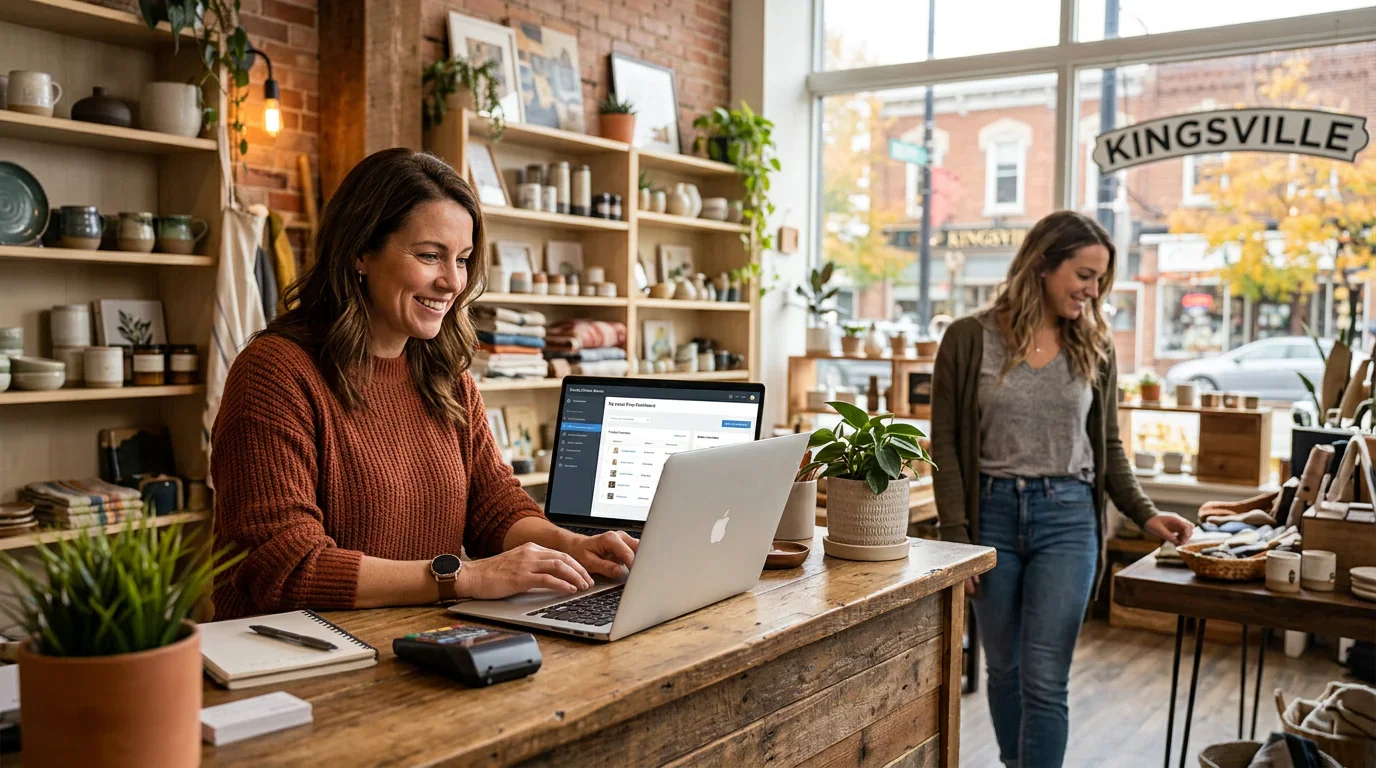

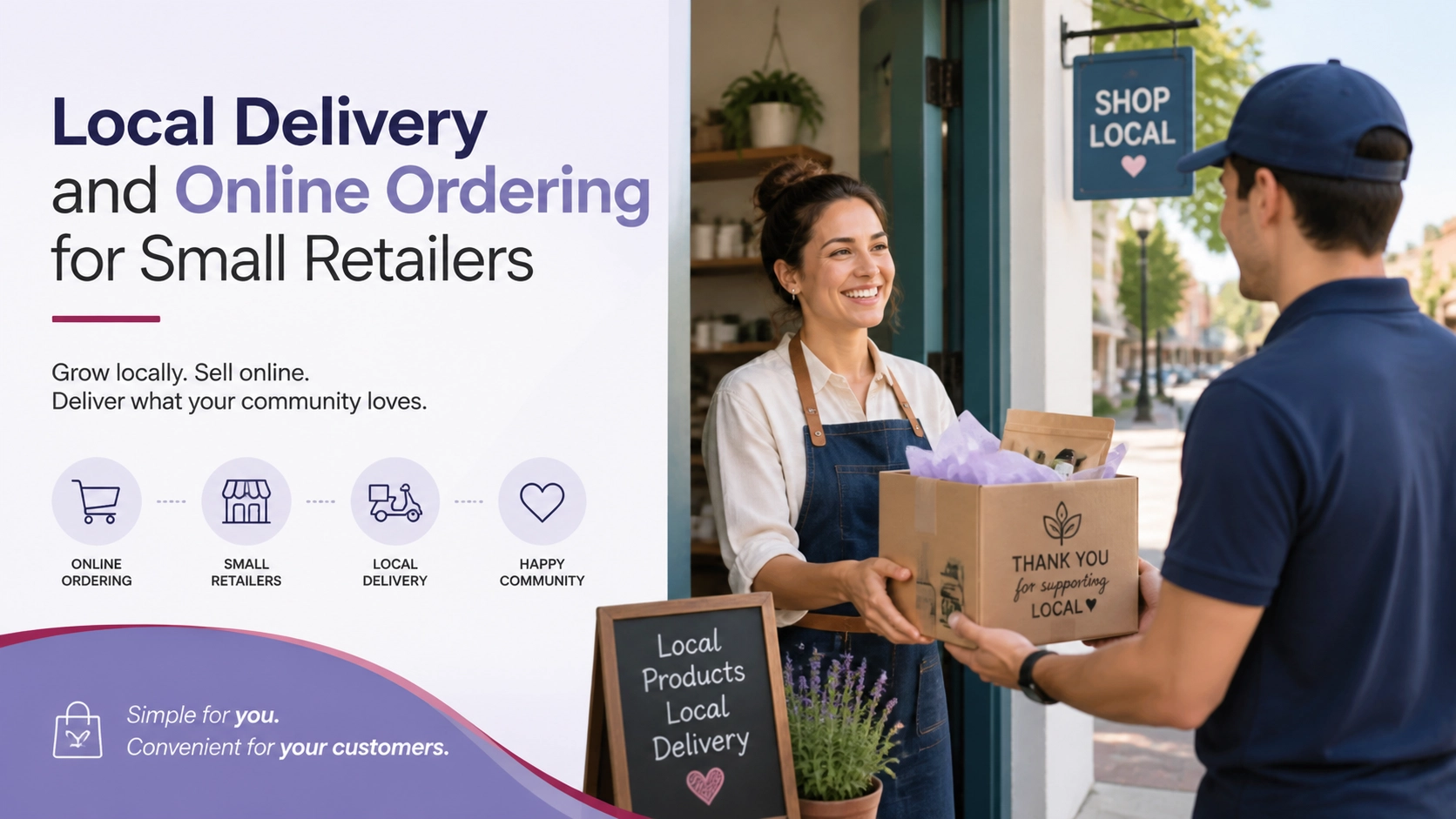
A customer in Kingsville opens her laptop at 2 PM on a Tuesday. She needs a birthday gift for a coworker by 6 PM. She has two options: order from Amazon and hope the two-day shipping somehow arrives in four hours, or drive into town, find parking, and walk three stores until she finds something suitable.
There's a third option she doesn't know exists: ordering from your shop online and having it delivered to her door by 5 PM, wrapped and ready.
That third option is the one most local retailers in Windsor-Essex haven't built yet. And it's the one that turns geography from a liability into your strongest competitive advantage.
The Local Advantage: Amazon Delivers in 2 Days, You Deliver in 2 Hours
For the past decade, small retailers have been told to compete with Amazon by being more like Amazon: bigger selection, lower prices, faster shipping. That's a losing fight. Amazon will always have more inventory and a logistics network you can't match.
But Amazon has one weakness that local retailers consistently fail to exploit: distance.
Amazon's nearest fulfillment centers to Windsor-Essex are hours away. Their fastest delivery to Kingsville is next-day if you're a Prime member, two days otherwise. Their drivers don't know your customer's neighborhood. They don't know the side door is around back. They can't gift-wrap. They can't take returns at the counter. They can't tell your customer that the blue one looks better with what she described.
You can be at her front door in under an hour.
That's not a small advantage. That's the entire game. Same-day delivery within a 15-kilometre radius is something Amazon cannot offer at any price point in our region. When you offer it, you are not competing with Amazon. You are offering a service Amazon does not have.
The mistake most retailers make is treating online ordering as a defensive move, something to do because everyone says you need a website. It's actually an offensive move. It lets you reach customers who would never drive to your store but happily buy from you when delivery is two hours instead of two days.
What Online Ordering Looks Like for a Small Retailer
If the phrase "online store" makes you think of a giant catalog with thousands of products, expensive monthly fees, and a tech team to manage it, set that aside. That's the enterprise version. The version that works for a small retailer in Windsor-Essex is much simpler.
You need three things:
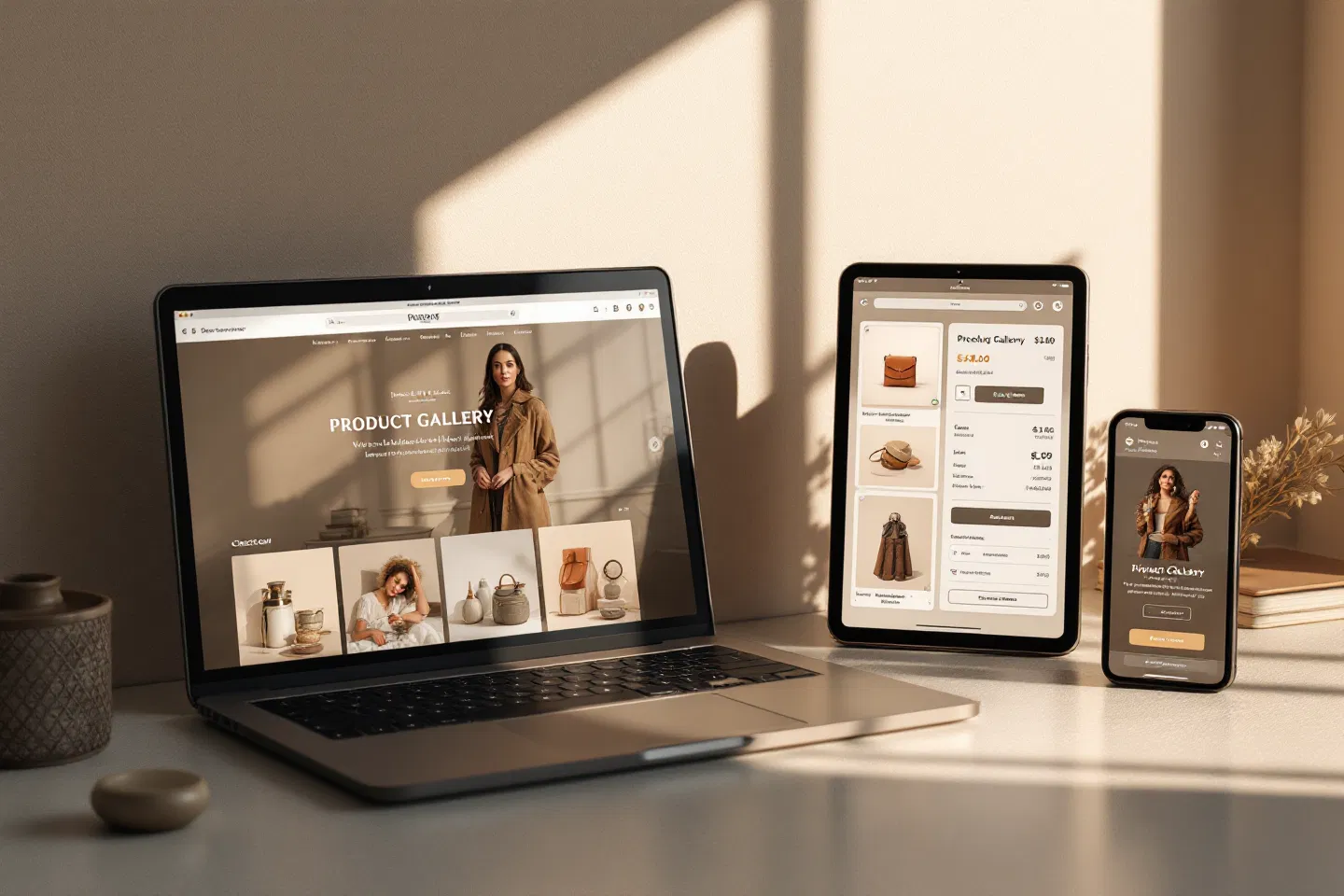
A product page that shows what you sell with a clear photo, a short description, the price, and a button that says "Add to cart." That's it. Customers do not need 360-degree videos or augmented reality try-ons. They need to see the item, know it's in stock, and add it to their order.
A cart that lets them keep adding items and shows the running total. This is standard on any modern store platform.
A checkout that asks for their name, address, payment, and one critical choice: delivery or pickup.
That last part is what separates a retail website from a national e-commerce site. A national site only ships. Yours offers two paths, both faster and more convenient than waiting on a courier from Toronto.
You don't need 500 products listed online to start. You can start with 20. Pick your bestsellers, your highest-margin items, and the things you're most often asked about. Add more over time. The store does not have to mirror your entire physical inventory on day one.
For more on why you don't need a massive enterprise platform to do this, see You Don't Need Shopify.
Delivery Logistics: Making It Work Without a Fleet
The biggest fear retailers have about offering delivery is logistics. How do I get the order from the shelf to the customer's door without hiring a driver, buying a van, and rebuilding my whole operation?
The answer is to keep it simple and bounded.
Radius-Based Delivery
Set a delivery radius you can actually serve. For a Kingsville shop, that might be Kingsville, Leamington, and parts of Essex. For a Windsor shop, maybe a 10-kilometre circle around your storefront. Anything outside the radius gets shipped via Canada Post or pickup only.
The radius matters because it caps your time commitment per delivery. A 15-minute drive each way is manageable. A 90-minute round trip is not, unless the order is large enough to justify it.
Most modern store platforms can be configured so that customers entering a postal code outside your radius simply don't see delivery as an option at checkout. The system handles the boundary for you.
Delivery Windows
Don't promise instant delivery. Promise specific windows. Two common patterns work well for small retailers:
- Same-day delivery for orders placed before 1 PM, delivered between 3 PM and 6 PM. Anything after 1 PM ships next business day.
- Two delivery runs per day, say 11 AM and 4 PM. Orders are batched into the next available run.
Batching is the key to making delivery economical. Driving five orders at once on a planned route costs you 90 minutes total. Driving each one separately as it comes in costs you all afternoon and most of your fuel budget.
Pricing the Delivery
Three options work, and you can offer all three:
- Flat-rate delivery at a fee that roughly covers your fuel and time. Five to ten dollars is typical for short-radius local delivery.
- Free delivery over a threshold. Orders over 75 dollars ship free, for example. This nudges average order value up and protects your margin on small orders.
- Free pickup as the always-available option. Costs you nothing, drives traffic into the store.
Free shipping has become an expectation online, but customers understand local same-day delivery is different. They are paying for speed, not for postage. A reasonable flat fee is not a deal-breaker when the alternative is two days of waiting.
The Pickup Option: The Underrated Workhorse
Click-and-collect, also called buy-online-pickup-in-store, is the most under-used feature in small retail. It costs you nothing to offer, eliminates shipping costs entirely, and brings the customer into your store, where they often add to their order.
Here's how it works in practice. A customer browses your site, adds three items to her cart, and at checkout selects "Pickup at store" instead of delivery. She pays online. You get the order, pull the items, set them aside with her name on them. When she walks in, she shows ID or her order confirmation, and you hand over the bag. Total time at the counter: under a minute.
Why this matters:
- She skipped the parking-and-browsing time, which is the friction that often keeps her from coming in at all.
- You captured the sale while she was thinking about it, not three days later when she forgot.
- She's now in your store. Maybe she sees something else and adds to the order. Maybe she comes back next week.
- You paid zero in delivery costs.
For retailers in walkable areas like downtown Kingsville, Walkerville, or Old Sandwich Town, pickup is often the dominant fulfillment method. Customers want to support you and don't mind a 10-minute walk. They just don't want to browse for an hour to find one specific thing.
The Shop Local Kingsville movement runs on exactly this dynamic: customers who want to buy local but need the convenience of knowing the item is reserved before they make the trip. For more on the local-first opportunity, see Shop Local Kingsville.
Marketing: Tell People You Do This
Building the system is half the job. The other half is making sure your customers know it exists.
Every retailer who launches online ordering goes through the same surprise: nobody uses it for the first month. Then they realize they never told anyone. Then they start telling people, and orders begin.
The marketing message is simple and concrete:
"Order online, delivered to your door in Kingsville by 5 PM."
That sentence does more work than a paragraph of generic e-commerce copy. It names the town. It names the time. It promises something Amazon cannot match. Use variations of it everywhere:
- A banner at the top of your website
- The pinned post on your Facebook and Instagram pages
- A printed card in every customer's bag at the register
- A sandwich board outside the shop
- The voicemail greeting: "If you'd rather order online for delivery or pickup, visit our website at…"
- An email to your customer list announcing it
- A simple sign in your window: "We deliver locally. Order at [yoursite.com]"
Repeat it for three months before you decide whether it's working. Most customers need to see a new option three or four times before they try it. The retailer who launches an online store, sends one email, and concludes "nobody wants this" gave up before the message landed.
The Technology: Simpler Than You Think
Here's what you actually need to run local ordering and delivery as a small retailer:
A Simple Online Store
A WordPress and WooCommerce site, or a similar lightweight platform, handles product listings, cart, checkout, delivery zones, and pickup options. Setup cost is a fraction of enterprise platforms, and there are no monthly transaction fees on top of payment processing.
Payment Processing
Stripe, Square, and Moneris all integrate with most store platforms and let you accept credit cards, debit, and digital wallets like Apple Pay. Transaction fees are typically 2.5 to 2.9 percent plus a small per-transaction fee. That's the cost of doing business online and is built into your pricing.
Delivery Management
For a small shop doing 5 to 20 deliveries a day, you do not need delivery management software. A printed list, a route on Google Maps, and a phone for confirmation calls is enough. When you grow past 30 deliveries a day, look at tools like Routific or Circuit, which optimize multi-stop routes automatically. Until then, keep it simple.
Inventory Awareness
If an item sells out in the store, the website needs to know so the next online customer can't order it. Most store platforms handle this automatically when you ring sales through their connected point-of-sale system. If your in-store POS doesn't sync, set a daily routine: end of day, update online stock for any sold-out items. Five minutes of work prevents the worst customer experience in retail, which is selling something twice.
Success Stories from Local Businesses
The retailers winning at this in Windsor-Essex are not chains. They are independents who decided to compete on speed and service rather than price and selection.
A Kingsville home goods shop launched online ordering during the pandemic with 40 products and same-day local delivery. Three years later, online orders account for 25 percent of revenue. The owner does deliveries herself on a fixed afternoon route, which she's said is the most efficient marketing she does. Customers see her van in their neighborhood and remember the shop exists.
A Leamington bookstore added pickup-only ordering with no delivery at all. The simple promise: order by phone or website, have your books waiting at the counter. Within six months, pickup orders were 15 percent of weekly sales, and the store reported that pickup customers spent more on average than walk-ins because they came in knowing exactly what they wanted and often added a coffee or a second book at the counter.
A Windsor specialty food shop offers both delivery and pickup, with a 50-dollar threshold for free delivery. The threshold pushed average order value from 32 dollars to 58 dollars within two months, and it normalized larger orders that the customer would have split into two visits previously.
None of these businesses had a tech team. None of them had previous e-commerce experience. They started with a simple store, 20 to 50 products, and one consistent message: order from us, get it today, support a local shop.
What to Do Monday
If you run a retail shop in Windsor-Essex and don't yet offer online ordering, here is the smallest viable starting point:
- Pick 20 products. Bestsellers and high-margin items first.
- Take clean photos of each on a plain background. A phone camera is fine.
- Set a delivery radius and pricing. Start conservative; expand later.
- Pick two daily delivery windows, or one if your volume is low.
- Launch with a soft announcement to your existing customers via email and social media.
- Repeat the announcement weekly for the first two months.
The retailers who delay this are not avoiding cost. They are paying it elsewhere, in lost sales to Amazon, in customers who have already moved their habits online, in foot traffic that isn't coming back without a reason. Online ordering is the reason. Local delivery is the reason. Pickup is the reason.
You do not need to be Amazon. You need to be the shop that delivers to her door by 5 PM, and tells her so.
Doorways Into Your Business builds online stores with local delivery and pickup for small retailers across Windsor-Essex. If you're ready to give your customers a faster alternative to Amazon, book a free consultation at https://blog.diyb.ca/contact-diyb.